Warning: Constant WP_CRON_LOCK_TIMEOUT already defined in /home3/santork0/public_html/wp-config.php on line 102

Warning: Constant AUTOSAVE_INTERVAL already defined in /home3/santork0/public_html/wp-config.php on line 103

Warning: Constant WP_POST_REVISIONS already defined in /home3/santork0/public_html/wp-config.php on line 104

Warning: Constant EMPTY_TRASH_DAYS already defined in /home3/santork0/public_html/wp-config.php on line 105
Santorini caldera – Photos of Santorini

Tag: Santorini caldera

  • The stunning Santorini view walking from Imerovigli to Oia

    The stunning Santorini view walking from Imerovigli to Oia

    This is one of the numerous spectacular views from the bit of land to the north of Imerovigl not long after sunrise. You can walk from Imerovigli to Oia in a couple of hours and enjoy endless stunning views of the Greek Island of Santorini

    There are many great views when you are on the island of Santorini. I love just walking about on this wonderful Greek Island seeing what I find – this is the best way to find photo locations for me.

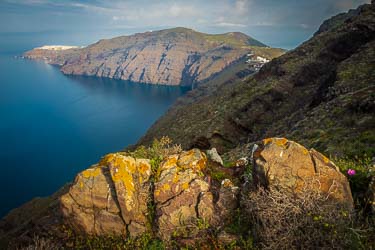
    I love this stunning Santorini view. This was taken after photographing the sunrise from the caldera. The sun had just reached these two rocks which I was sat near and I just had to take this shot which I absolutely love.

    Why do I like this photo so much?

    I love the depth in the image, which has been created by the light and how it interacts with the landscape. The sunlight has illuminated the rocks in the foreground, but not the areas around. The rocks were sticking up just enough to for the sunlight to illuminate them for that brief moment just before the sun lit the part in shade in the photo.

    This was a fleeting moment that I was thankfully aware of and able to capture as it happened – 30 seconds later and the moment was gone.

    I love the depth in this image, with the foreground interest and that lovely morning sunlight and the caldera running away down to Oia in the background.

    This is what landscape photography is all about for me – capturing stunning views and fleeting moments lost forever.

    How did I decide on this composition?

    Quickly! No time to think with this one.

    I was sat on these rocks after photographing the sunrise, which was coming in from the right. The rocks were actually my temporary base for this shoot. What I do is put my camera bag on something nice and solid and not too close to the edge of the caldera – accidents happen, especially to someone as clumsy as me!

    And this mornnig it was those very rocks that I put my gear on.

    I was sat on the rock debating what to do next, and having a rest, when the sun hit these rocks and I knew straight away that there was a photo to be made here.

    Composition was quick to capture the fleeting moment which I am so glad I caught.

    Where was the photo taken?

    Right where the orange tab is.

    Right there. How ridiculously precise is this GPS stuff! Zoom in when you are using the Map Module in Lightroom and see just how precise the data is – I could go back to that exact spot if I wanted to – absolutely amazing. And a great example of technology working across devices, the data being recorded on my Canon 6D and turned into meaningful data using Lightroom.

    What time of day was the photo taken?

    6:31am. Just after sunrise. And just as the sun hit the rocks in the foreground. Obviously.

    What photography gear did I use to get the shot?

    • Canon 6D
    • Canon 24 – 105mm F4 L Lens (focal length used 17mm)
    • Manfrotto 190 Go tripod with geared head
    • Peak Design Everyday Backpack
    • Loupe Viewer
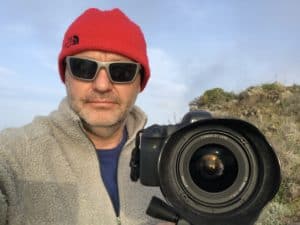
    • Red hat – still cold
    • Oakley sunglasses
    • Red shoes (not aching yet)
    • Coke Zero and melted chocolate

    Happily for this image I have some shots of some of my gear on location on the Santorini caldera. Here you can see what I am pointing my camera at.

    And here is my Peak Design Everyday Backpack next to my Manfrotto 190 Go tripod.
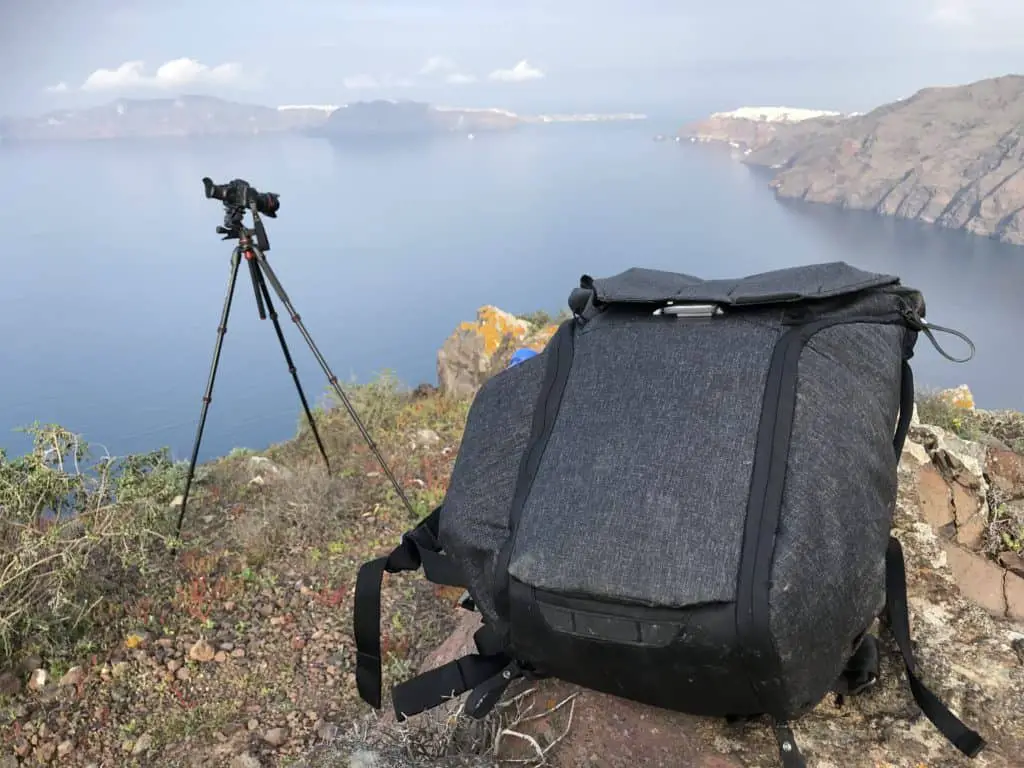
    Peak Design Everyday Backpack on the Santorini caldera
    Peak Design Everyday Backpack on the Santorini caldera

    What camera settings did I use?

    • Aperture F22
    • Shutter speeds 1/160th second, 1/640th second and 1/40th second.
    • ISO 400
    • Back-button focus
    • Focal length 28mm
    • AV Mode
    • 10 second self-timer
    • RAW format

    I used F22 as I needed the maximum depth of field, as I was pointing my camera down on the rocks which I needed in focus, as well as the end of the caldera.

    One interesting fact about the image.

    Look how precarious my tripod is. Seriously is that how I actually took the photo? I honestly can’t remember, but it looks rather odd and hardly an example of text book use of a Manfrotto tripod!

    Manfrotto 190 Go tripod on the Santorini caldera

    Maybe it is just the angle that I took this photo on my iPhone with?

    Is there a behind the scenes video of this shoot?

    Yes. And here it is on my YouTube channel. You can see how much of an afterthought this image is – the rocks appear right at the end of shooting! they just creep in on the right at the end.

    That was the point at which I realised there was a potential shot to be made!

    How did I process the image?

    This is the global processing of the complete image in Lightroom. But for this image I want to talk about something else.

    How I processed this <a href=
    view of Santorini in Lightroom” width=”790″ height=”430″> How I processed this view of Santorini in Lightroom

    And the something else is local adjustments. And more specifically one of my favourite tools in Lightroom, the radial tool.

    This is the area selected using the radial tool, and you can see what I am doing here to the area in red only.

    I am lightening the rocks and adding some clarity to the rocks to bring out the textures just in the rocks.

    How I processeed this view of Santorini

    This is done to make the rocks more prominent, giving the foreground a focal point before the eye goes into the scene beyond.

    The eye is drawn to the lightest part of a picture, and I wanted that to be the rocks n the foreground and not the white buildings on the top of the caldera.

    What could I have done to improve this image?

    Well that is a question. How could I have improved this image?

    Being critical of my composition I could have given more space to the left of the headland and the town of Oia – a bit more sea would have given the image more space. I used a 28mm focal length on my Canon 24-105mm lens so there was some lattitude there but this was clearly a conscious decision to frame this composition.

    I try to get the composition just right in camera, and do not like shooting wider than I want to knowing I can crop in later – my mind does not work like that.

    In terms of processing I could have removed some of the (natural!) white marks from the rocks, and maybe the pink flower to the right. And the whie buildings in the middle.

    I have not removed these things as they are there and for me part of the scene. Not that I am a die hard purist – I have removed bigger distractions than these from my photographs before.

    And what are my thoughts on this image?

    I really like this image. There a lovely sense of depth to the scene, with the sun illuminating the rocks in the foreground, whilst the adjacent land is still in shade. The southern facing cliffs of the Santorini caldera are the first to catch the morning sun as well as the town of Oia at the end of the caldera.

    You can see a few white buildings behind the shaded part of the land which you walk past on the path from Imerovigli to Oia.

    All in all an image I am very happy with.

    Enough of me – what do you think of this image?

    OK – you have read what I have to think about this image, what do you think? Please let me know, as I love to hear feedback on not only my images of Santorini but also what I have written about my photographic work.

    One last thing
    If you want to buy this image, or want to speak to me about future collaboration email me at sales@rickmcevoyphotography.co.uk.

    Rick McEvoy ABIPP – Photographer, writer, blogger
     

  • How high is the Santorini Caldera – check out this photo

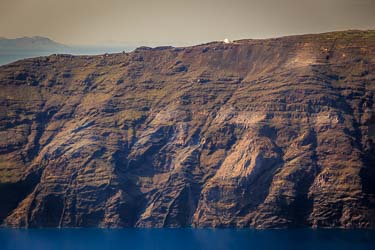
    How high is the Santorini Caldera – check out this photo

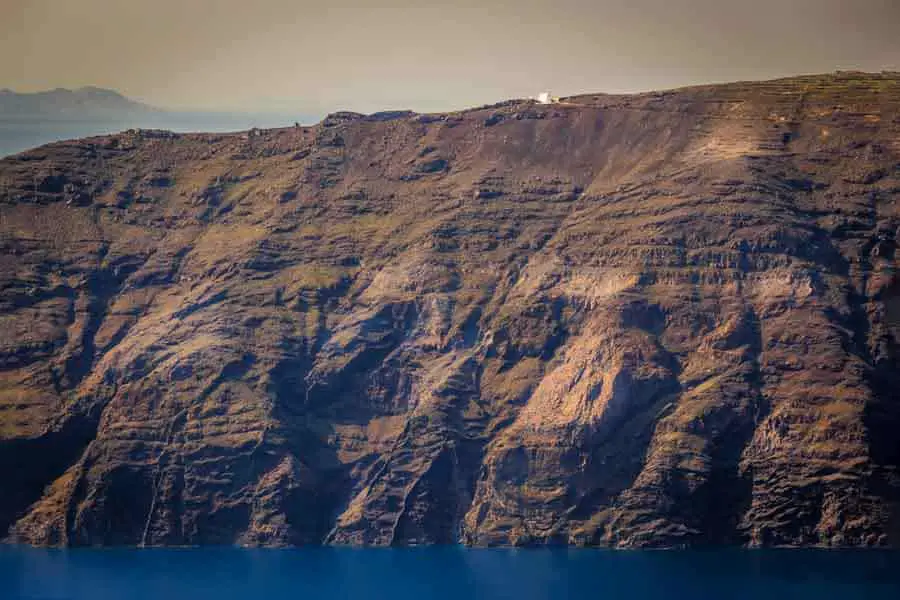
    The view of the Caldera photographed from near Imerovigli showing the scale of the natural caldera. There is a single white building on the top of the Caldera, a small Greek Church.

    I was excited to get to Santorini to explore and photograph the wonderful landscape created by a volcanic eruption years ago.

    And there was a question I had asked myself before I arrived – how high is the Santorini caldera? This photo shows how high it is. Ok well it doesn’t, but it gives you an idea of the scale.

    And in actual numbers, the highest point of the Santorini caldera is 367 metres high (which in old money is 1,204 feet).

    Why do I like this photo so much?

    The simplicity of the image. The mass of the caldera and one small white building on the top.

    And the fact that it was visually answering the question “how high is the Santorini caldera?” – one of the questions I took with me in my confused head all the way from England to the stunning Greek Island of Santorini.

    This contrast is a metaphor for the relative stature of humans and the planet, the natural world against the man made world.

    I sometimes include people in my photos is to provide a sense of scale – here the small white church does just that.

    How did I decide on this composition?

    When I am out on a location shoot I look all around me to see what other possible compositions there are. I often do this once I have made my sunrise composition and am sat there waiting for the sun to rise.

    Once I have captured a sunrise that is that image capture done. I move on to the next thing. And that includes taking advantage of that early morning directional light giving scenes like this depth and dimension.

    And of course possible compositions for later in the day.

    I actually spotted this church as I was walking away from the sunrise shoot, and was rather taken with the view, but the light was not right at the time.

    I returned after lunch, and the sun had moved round enough to give some pleasing light.

    The white church was prominently illuminated by the early afternoon sun. It was then that I was struck by the significance of the one white building – when I looked at the composition on my LCD screen the white building stood out, whilst at the same time looking so insignificant and small.

    This was the point of interest for me in this composition – the tiny white Greek Church dwarfed by the caldera formed by a volcanic eruption years ago. This picture answered that question nicely for me.

    And the picture also conveyes the precarious nature of the development of Santorini – small buildings placed on the top of that massive natural structure.

    Where was the photo taken?

    Right there where the number 54 is. Yes this was a great location clearly.

    What time of day was the photo taken?

    Twenty past two in the afternoon. This part of the caldera was in shade at sunrise but by early afternoon the sun had moved around enough that the light was directional enough to give the shadows you can see. At sunset this part of the caldera would be in shade.

    This puts paid to the incorrect general view that you should only shoot in the hours around sunrise and sunset – utter nonsense. You should shoot any scene at the time at which the light works to compliment the scene.

    Or at the time when you can get there – life is not that simple for us mere mortals.

    What photography gear did I use to get the shot

    • Canon 6D
    • Canon 70-200mm F4 L lens
    • My hands
    • Loupe viewer
    • Red shoes
    • Water
    • No hat required

    What camera settings did I use?

    • Aperture – F8
    • Shutter speed – 1/1000th second
    • ISO 400
    • Focal length – 169mm
    • AV Mode
    • Back button focus
    • Single image capture
    • Hand held

    One interesting fact about the image.

    It was taken after lunch. Not long after 2pm, when the sun is at its highest. And it’s hotter! I really noticed that.

    Yes the time they all say you shouldn’t be taking photos, with that flat dull overhead lighting.

    And also the fact that I used my telephoto lens for this shot. I normally carry it around paired with my 17-40mm lens for scenes just like this one.

    Is there a behind the scenes video of this shoot?

    No – not for this shot. I was getting rather tired, as I had been on my feet since 4am without any kind of break. I had a beer when I got back and a little sleep before sunset though!

    The shot was hendheld – not even I can video myself taking a photo handheld! Well I could have used my tripod….

    And this is an ever rarer shot being a single image and not an HDR capture.

    How did I process the image?

    Well I was starting with a single image, so I had to make it look and feel like the other images in this set – I didn’t want it to stand out or look different.

    I did global adjustments in the Basic Panel in Lightroom, and then local adjustments, mainly dodging and burning.

    I dodged the white building, giving an exposure increase and moving the whites slider to the right.

    I dodged and burned parts of the face of the caldera to emphasize the lights and the darks, giving the image more dimension and depth.

    Dodging and burning is the term used to selectively lighten (dodging) or darken (burning) parts of an image. The term originated in the film days, and was a technique used in printing.

    What could I have done to improve the image?

    If I had lowered my camera slightly I could have excluded the island in the background, which I believe is the small Greek Island called Sikinos.

    Sure I could remove this in Photoshop, but I haven’t done so as this was the scene I photographed. I only tend to remove blemishes and imcomplete things in Photoshop, not whole islands. And every now and then I have to add things in after a drastic correction of the horizon!

    And I could have taken the shot in portrait mode, zooming in more to make more of the relative sizes of the caldera and the church.

    That would have not necessarily made for a better image, but would have given a different perspective.

    I used my telephoto lens, using a focal length of 169mm. It is easy to forget that one of the best lenses for landscape photography is actually a telephoto lens.

    And what are my thoughts on this image?

    It works for me. I wanted to convey the scale of the caldera, which I have done I feel with the inclusion of one white Greek Church.

    It is a single image catpure, fine for daylight shooting where there is slightly less dynamic range to capture.

    And this photo visually answered the question about the height of the Santorini caldera.

    Enough of me – what do you think of this image?

    Please let me know your thoughts on this image – have I achieved the objective I set out to achieve? have I conveyed what I have written about in this post?

    One last thing

    If you want to buy this image, or want to speak to me about future collaboration email me at sales@rickmcevoyphotography.co.uk.

    Rick McEvoy ABIPP – Photographer, writer, blogger